
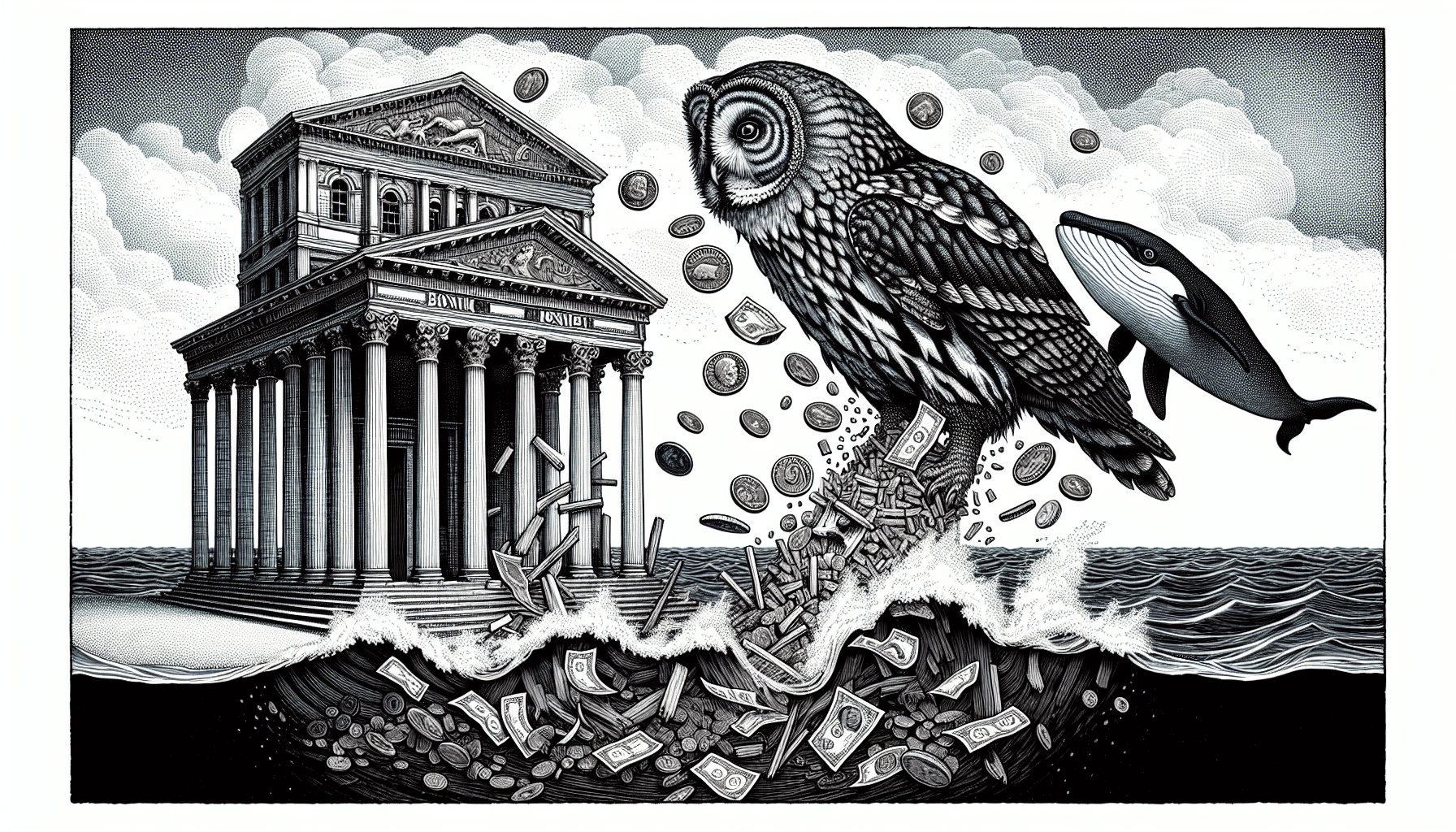
Blue Owl's $1.4 Billion Fire Sale Just Triggered 2008 Flashbacks. Here's What It Means for Bitcoin.
Private equity firm Blue Owl Capital dumped $1.4 billion in assets this week to pay investors scrambling for the exits. The stock cratered 14% in five days and is now down over 50% year over year. And some very smart people are starting to say very scary things.
Former Pimco chief Mohamed El-Erian called it a "canary in the coalmine" moment. He compared it directly to August 2007, when two Bear Stearns hedge funds collapsed under the weight of subprime mortgage losses. That was 13 months before Lehman Brothers went under and the entire global financial system nearly fell apart.
So are we looking at another 2008? Probably not. But the parallels are close enough to pay attention.
Private Credit's Growing Problem
Here's what happened. Blue Owl runs a retail-focused private credit fund. Investors wanted their money back. The fund didn't have the liquidity to meet redemptions. So Blue Owl had to sell $1.4 billion in loans at whatever price the market would give them.
That's a forced liquidation. It's exactly how contagion starts.
The damage didn't stop at Blue Owl. Blackstone, Apollo Global, and Ares Management all took hits this week. Former Peter Lynch associate George Noble suggested Blue Owl could be the "first domino" in a broader private credit unwind.
Private credit has ballooned over the past few years. Firms chased yield in a higher rate environment by lending to companies that couldn't access traditional bank loans. It worked great when rates were rising. Now that the cracks are forming, the question is whether this is an isolated problem or something systemic.
I think it's somewhere in between. Blue Owl's situation looks specific to their fund structure and investor base. But the private credit space has gotten crowded, borrowing has crept up, and there isn't much transparency into what these funds actually hold. That combination makes me nervous.
Why Bitcoin Cares
Bitcoin wasn't around for 2008, but it was literally born because of it.
Satoshi Nakamoto embedded a newspaper headline into Bitcoin's first block on January 3, 2009: "Chancellor on brink of second bailout for banks." The entire project was a response to the failures of the traditional financial system.
Here's the playbook we've seen before. Credit stress hits. Markets panic. The Fed steps in with massive liquidity injections. And Bitcoin goes on a tear.
We saw it in 2020. Covid triggered a financial panic. Bitcoin crashed 70% from mid-February to mid-March. Then the government pumped trillions into the economy, and BTC went from under $4,000 to over $65,000 in about a year.
If Blue Owl turns out to be a genuine canary, the sequence would look similar. Short term pain for risk assets, including crypto. Then central bank intervention. Then a massive rally as all that new liquidity needs somewhere to go.
Arthur Hayes made a similar argument earlier this week, writing that the current AI spending bubble mirrors the conditions that preceded previous financial crises. His thesis is simple: the bigger the crisis, the bigger the Fed response, and the bigger the bitcoin rally that follows.
The Whale Problem
But there's a catch. And it's sitting right in the on-chain data.
Santiment data published today shows retail investors have been buying bitcoin steadily. Wallets holding less than 0.1 BTC have increased their holdings by 2.5% since October's all-time high. The "shrimp" share of supply is at its highest level since mid-2024.
Whales are doing the opposite. Wallets holding between 10 and 10,000 BTC have reduced their positions by about 0.8% over the same period.
That split matters a lot. Retail can provide a floor. They can spark short-term momentum. But rallies that actually stick need big money behind them. When whales are distributing into every recovery, rallies get sold into before they can build any real momentum.
Glassnode's Accumulation Trend Score briefly hit 0.68 after bitcoin's flash crash to $60,000 on February 5th. That suggested broad accumulation was happening. Mid-sized wallets in the 10 to 100 BTC range were aggressively buying the dip.
But Santiment's wider lens tells a different story. Across the full 10 to 10,000 BTC range, net positioning since October is still negative. The largest holders kept distributing into every recovery, dragging the aggregate number down.
So we've got a market where retail is showing up but the big players aren't. That's a recipe for choppy, frustrating price action. Which is exactly what we've gotten. Bitcoin has been stuck in the mid-$60,000s for most of February.
Where We Stand Right Now
Bitcoin is trading around $68,450 as of this morning. Up about 1.8% in the last 24 hours. The Fear and Greed index sits at 58, which is "Greed" territory but nothing extreme. ETH is at $1,988, up 2%. Solana is at $86.36, up about 2%.
The market shrugged off a potentially huge development yesterday when the U.S. Supreme Court ruled Trump's global tariff rollout illegal. Trump immediately announced new tariffs under Section 122, and crypto barely flinched. That's either a sign of resilience or exhaustion. I'd lean toward exhaustion.
There's also an interesting development from the SEC. They quietly changed their FAQ to let broker-dealers count stablecoin holdings as regulatory capital with just a 2% haircut. Before this, stablecoins were basically zeroed out on balance sheets. Now they're treated like money market funds. That's a big deal for institutional adoption, even if nobody's talking about it yet.
My Take
I don't think Blue Owl is going to cause a 2008-style meltdown. The scale isn't there. But I do think it's an early warning signal that private credit has gotten too big, too fast, with too little oversight.
For bitcoin specifically, the short-term picture is murky. Whales aren't accumulating. The market is range-bound. Volume is muted.
But the macro setup is getting interesting. If private credit stress spreads, we'll see some version of the same playbook: pain first, then intervention, then a flood of liquidity. And when that happens, bitcoin tends to be one of the biggest beneficiaries.
The shrimps are already positioned. They're doing their part. Now we're all just waiting for the whales to show up.
Stay ahead of the market
Get daily crypto analysis delivered to your inbox. No spam, unsubscribe anytime.
Related Articles

The Fed Is Done Cutting Rates and Crypto Doesn't Care
The Federal Reserve has paused rate cuts indefinitely. Traditional markets are rattled. But Bitcoin barely flinched. Here's why that matters.

Bitcoin's Worst Start to a Year Ever. Here's Why Miners Don't Care.
Fifty days into 2026 and bitcoin is down 23%. That's the worst start to any year in its history. And yet mining difficulty just jumped 15%, the biggest single increase since 2021. Miners are coming back hard even as the price bleeds. So what gives?
Institutions Won't Stop Buying Crypto. Retail Investors Can't Stop Selling. Who's Right?
Bitcoin is sitting at $68,000. Down 21% on the year. The Fear and Greed Index reads 41. Memecoins are bleeding. Retail traders are panic selling into every bounce. And yet, right now, some of the biggest money in the world is quietly backing up the truck. Strategy just bought another $168 million in bitcoin. BitMine dropped $90 million on ethereum in a single week. An Italian bank with $900 billion in assets just disclosed $100 million in bitcoin ETF holdings. These aren't dumb money moves. Th